
The Single Shift That Turned Hieroglyphs Into the ABCs We Use Today
How ancient merchants turned a complex system of divine symbols into a pragmatic tool for trade by ignoring what things looked like and listening to how they sounded.


If you have ever tried to learn a new language, you know the frustration of memorizing arbitrary rules. Now, imagine if every word you wrote required you to draw a miniature bird, a basket, or a human leg. For millennia, this was the reality of literacy in the Mediterranean. The leap from the dense, beautiful hieroglyphs of Ancient Egypt to the stark, efficient 22 letters of the Phoenician alphabet is not just a story of linguistic evolution; it is a story of cognitive hacking. It represents the moment humanity stopped drawing things and started drawing mouth noises.
We often credit the Greeks with "inventing" the alphabet as we know it, but the heavy lifting—the actual mental revolution—happened centuries earlier on the harbors of the Levant. The Phoenicians didn't just create a script; they dismantled the elite monopoly on information.
The Myth That Hieroglyphs Were Just Primitive Picture Writing
The most persistent myth about ancient writing is that hieroglyphs are essentially "emoji" for adults—primitive pictograms where a drawing of a sun means "sun" and a bird means "bird." This view sells the ancient Egyptians short. By the time the Phoenicians arrived on the scene, Egyptian writing was a sophisticated, complex system of logograms, phonograms, and determinatives that had been refined for over two thousand years.
The reality is that hieroglyphs were already phonetic. A scribe could use the symbol for a "mouth" (ro) not just to mean mouth, but to represent the sound 'R' in any word. However, the system was suffocatingly dense. A single word might require three symbols: one for the sound, one for the meaning, and one to classify the word type. It worked beautifully for carving monumental stone victories on temple walls, but it was a nightmare for the merchant class trying to calculate inventory on a rolling ship.
The complexity was a feature, not a bug, for the Egyptian priesthood. It preserved their power. In the same way that The Spartacus Myth vs. Reality obscures the brutal logistics of the arena to tell a hero's story, the complexity of hieroglyphs obscured the mechanics of reading from the common people. The "single shift" required ignoring 90% of what made Egyptian writing elegant.
Did a Single Genius Invent the Alphabet or Was It Necessity?
There is a romanticized notion that a solitary Phoenician merchant, perhaps named Ahiram or some anonymous genius, sat down around 1200 BCE and sketched out the first alphabet in a flash of inspiration. It makes for a great narrative—Newton under the apple tree style—but history rarely works in clean straight lines.
The innovation was likely messy, communal, and driven by the gritty realities of the Bronze Age collapse. As centralized empires faltered, international trade did not stop; it just moved faster. The Phoenicians, a maritime confederation of city-states like Tyre, Sidon, and Byblos, needed a lingua franca and a writing method that could keep up with the speed of commerce. They were dealing with dozens of languages and dialects across the Mediterranean. You cannot force a Greek trader to learn 700 Egyptian symbols just to buy a shipment of purple dye.
The cognitive leap was not creating a new system from scratch, but radically simplifying an existing one. They took the Egyptian hieroglyphs and stripped them of their meaning, keeping only the sound. They stopped asking "what does this drawing look like?" and started asking "what is the first sound of the word for this drawing?"
This mirrors the way economic bubbles often arise not from malicious intent, but from the frantic adaptation of systems to new pressures. Just as a Dutch tavern wager accidentally created a financial bubble by misunderstanding value, the Phoenicians accidentally created literacy by misunderstanding—or rather, intentionally misapplying—Egyptian art.
The "Acrophonic Principle" Was the Real Game Changer
The specific mechanism that turned pictures into letters is the "acrophonic principle," and it is the bridge between the ancient world and ours. It sounds academic, but it is incredibly simple. If I draw a picture of a house, in English you might say "House," so the symbol stands for 'H'. In Spanish, you might say "Casa," so the symbol stands for 'C'.
The Phoenicians applied this ruthlessly. They looked at the Egyptian hieroglyph for an ox head, which was stylized and triangular. In their Semitic language, the word for ox was aleph. So, they took the triangle, rotated it, and decided it would no longer mean "ox." It would simply represent the glottal stop or 'A' sound at the start of aleph.
They did the same for the floor plan of a house, which was beth. It became 'B'. A throw stick or window hook, waw, became a semivowel that eventually evolved into our 'F', 'U', 'V', and 'W'.
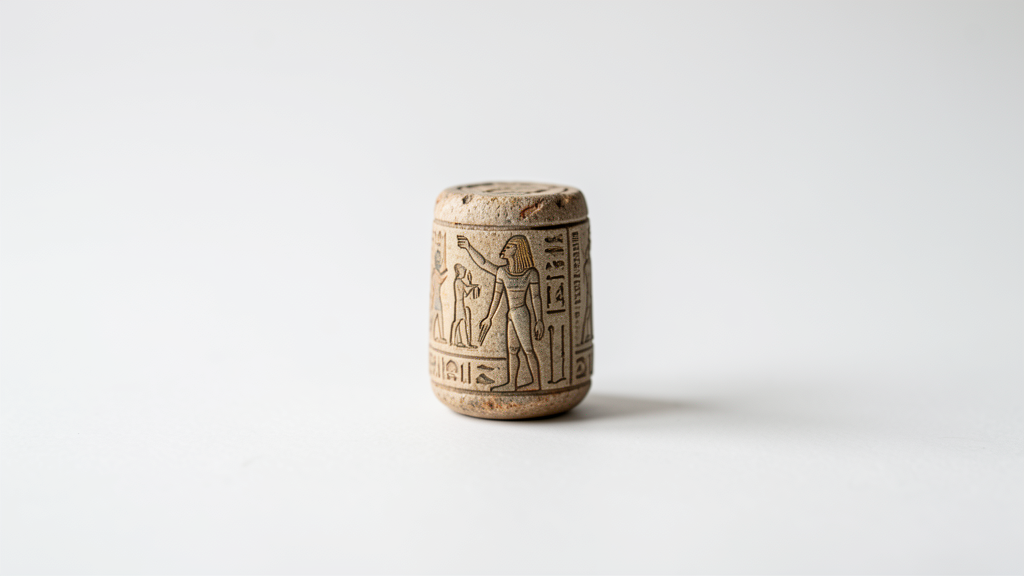
This was the "single shift." They stopped caring about the object depicted entirely. The ox head lost its horns and its biology to become a mathematical unit of sound. It was a move from concrete reality to abstract data processing. The picture became a cipher. This abstraction is what allowed the script to travel. The Greeks adopted these shapes around 800 BCE, kept the names (alpha, beta, gamma), but repurposed them for their own vowel-heavy language.
The Myth That the Alphabet Immediately Democratized Knowledge
We tend to assume that once the alphabet was invented, everyone immediately learned to read and the dark ages ended. The truth is more cynical. The Phoenicians were notoriously secretive about their trade routes and their methods. For centuries, the alphabet remained a tool of the elite merchants and record-keepers. It was a competitive advantage, not a public charity.
Furthermore, the early Phoenician alphabet was an "abjad"—it contained no vowels. Imagine trying to read this article without any vowels. "Mgnt tht trnd hrghyps ntc th ABCs s tdy." You could probably decipher it if you already knew the language, but learning it from scratch is a nightmare. This suggests that for a long time, the alphabet was less a tool for composing new thoughts and more a mnemonic shorthand for accounts and lists.
It took the cultural friction of the Mediterranean mixing pot—Phoenician trade meeting Greek philosophy—to force the next evolution. The Greeks, obsessed with the precise recording of their oral epics like the Iliad, found the lack of vowels unbearable. They repurposed symbols the Phoenicians used for consonants that didn't exist in Greek into vowels. The idea that an alphabet requires vowels is a Greek invention, not a Phoenician one.
The Phoenicians gave us the skeleton, but they didn't build the whole body.
Why We Still Struggle to Let Go of the Image
Even today, we have not fully let go of the Phoenician heritage or the urge to draw meaning. The capital letter 'A' is still an inverted ox head. 'B' is still a house. 'K' comes from the palm of a hand (kaph). Our keyboards are filled with the ghosts of Bronze Age objects that have not existed for millennia.
This persistence highlights a trade-off. We gained speed and universality, but we lost the visual poetry of the hieroglyph. When you look at an Egyptian inscription, you see a world of action—men plowing, birds flying, pots brewing. When you look at a Phoenician inscription, you see only dry data. This shift was necessary for the explosion of bureaucracy, science, and eventually, the digital age. You cannot run a spreadsheet with pictograms.
The tragedy of the Library of Alexandria is often framed as a loss of stories, but in a way, it was the ultimate victory of the alphabet over the image—the gathering of all the world's knowledge into a system of abstract, reproducible characters. If the burning of the Library of Alexandria really set humanity back, it was because the sheer volume of alphabetic data amassed there proved how powerful the Phoenician innovation had become.
The Legacy of the Abstract
The true power of the Phoenician shift was not that it made writing easier; it was that it decoupled language from the physical world. By forcing the symbol to represent only sound, and not the object itself, they created a universal adapter. Any language, no matter how different its nouns, could plug into this system.
We see the reverse of this shift happening right now in 2026. We are reverting to hieroglyphs through digital pictograms and emojis. We send an image of a face to convey an emotion, not a sound. It is faster, more intuitive, and more human. But for complex thought, for law, for science, and for history, we still rely on that brilliant, abstract reduction invented by sailors on the coast of Lebanon three thousand years ago. They taught us that to understand the world, you sometimes have to stop looking at it and just listen to the sounds you make when you try to describe it.
Read next
Did the Burning of the Library of Alexandria Really Set Humanity Back 1,000 Years?
Discover why the loss of the Great Library wasn't a fatal blow to human progress, but a symptom of a shifting intellectual world where knowledge was already migrating east.

How Did a Simple Bet in a Dutch Tavern Spark History’s First Financial Crash?
Discover how a casual drink between merchants turned into a 'wind trade' that shattered the Dutch Golden Age economy.