
Step-by-Step: How to Build a Cloud Chamber and Detect Cosmic Rays in Your Kitchen
Construct a diffusion cloud chamber using household materials to visualize the invisible subatomic showering your home every second.

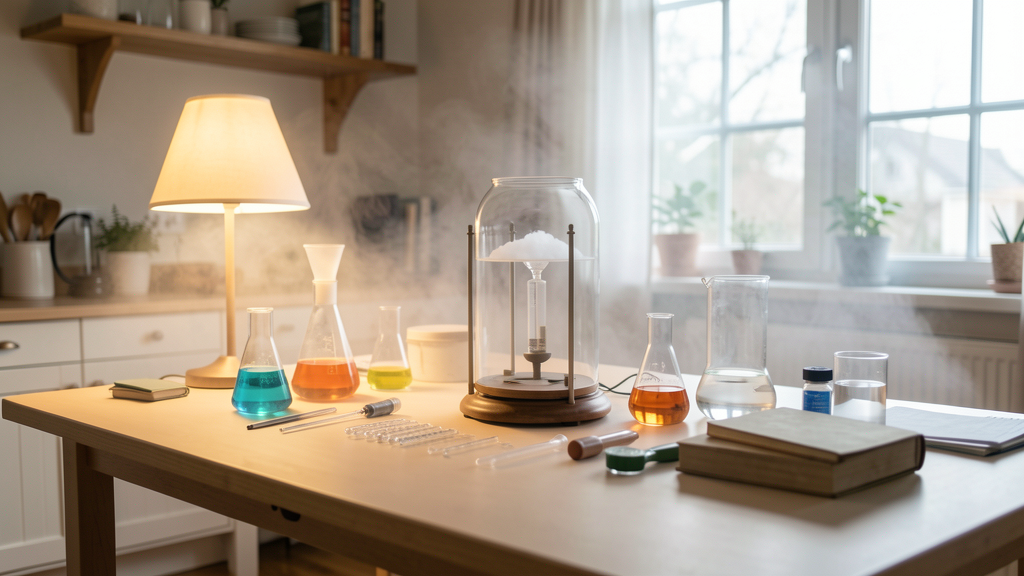
Right now, approximately 100 muons—elementary particles similar to electrons but 207 times heavier—are passing through your body every second. They are born in the upper atmosphere when cosmic rays collide with atomic nuclei, raining down on us in a constant, invisible subatomic storm. Most people go their entire lives without witnessing this, simply because the human eye is not equipped to detect the quantum world.
You do not need a particle accelerator the size of a city or a billion-dollar grant to see this. You need a clear container, some alcohol, and a source of extreme cold. We are going to build a diffusion cloud chamber. This device creates a supersaturated vapor layer where ionizing radiation leaves a visible trail, much like jet contrails in a clear sky.
The history of this discovery is rooted in happy accidents. Much like how a 'lazy' lab cleaning routine accidentally saved millions from sepsis, the cloud chamber was born from Scottish physicist C.T.R. Wilson’s fascination with cloud formation on Ben Nevis. He wasn't trying to detect particles; he was trying to replicate optical phenomena, but he stumbled upon a window into the atomic nucleus.
Why Supersaturation Matters
Before gathering materials, you must understand the mechanism you are about to exploit. A cloud chamber operates on the principle of supersaturation. By creating a steep temperature gradient—extremely cold at the bottom, warm at the top—we force alcohol vapor to float into a region where it is technically too cold to exist as a gas. It wants to condense into a liquid, but it lacks a "seed" or nucleus to grab onto.
In clean air, the vapor remains a super-cooled gas. However, when a charged particle zips through this unstable layer, it knocks electrons off air molecules, creating ions. These ions act as the perfect seeds. The alcohol vapor condenses instantly on them, creating a microscopic droplet that follows the particle's path. To your eye, these droplets form a thin, fog-like track.
Sourcing the Necessary Components
Precision here matters more than cost. You can build a functioning chamber for under $50, but using the wrong materials will result in a foggy box with no visible tracks.
- The Transparent Vessel: A glass aquarium or a large clear plastic petri dish works best. Avoid thin plastic storage containers; they often crack under thermal stress. You need a viewing area large enough to see across, ideally at least 20x20 cm.
- The Coolant: Solid carbon dioxide (dry ice). You will need about 2 to 3 pounds. Do not use regular ice; it is not cold enough to create the necessary temperature difference (dry ice is -78.5°C).
- The Working Fluid: Isopropyl alcohol (rubbing alcohol) with a concentration of 90% or higher. 70% alcohol contains too much water, which will freeze and obscure your view.
- Absorptive Material: A strip of felt or thick blotting paper that lines the inside top of the chamber.
- Light Source: A high-intensity flashlight or a LED panel.
- Radiation Source (Optional): While cosmic rays will provide a background show, having a radioactive source like a vintage Fiestaware plate (orange glaze) or a smoke detector americium source (extracted with extreme caution and proper knowledge) provides immediate, thick tracks. For this guide, we will rely on background radiation.
The Construction Sequence
Execute these steps in order. The thermal stability of the chamber depends on the setup phase.
Step 1: Prepare the Viewing Surface Take your glass or plastic container and turn it upside down. This inverted lid will eventually rest on the dry ice, so the interior surface of the lid becomes the "floor" of your chamber. Glue or tape black felt or black construction paper to the inside of this lid. A high-contrast black background is critical; white vapor trails are invisible against a white counter. Ensure the surface is matte, not glossy, to reduce glare.
Step 2: Install the Alcohol Reservoir Soak your strip of felt or blotting paper in the 90% isopropyl alcohol. It should be dripping wet. Affix this soaked strip to the inside walls of the container, near the top (which, when inverted, will be the ceiling). Gravity will pull the alcohol down, but the evaporation will rise toward the cold plate.
Step 3: Create the Cold Plate Using gloves and tongs, smash your dry ice into small chunks or a flat slab that fits the base of your container. Place a metal tray or a thick piece of Styrofoam on your table to protect it, then place the dry ice on top. If you use a metal tray directly, it will conduct heat away from the dry ice too quickly, causing it to sublimate faster.
Step 4: Seal the System Invert the container onto the dry ice. The rim of the container should make direct contact with the dry ice. If there are gaps, the cold air will escape, and the chamber won't work. You may need to weigh down the top of the container with a book to ensure a tight seal against the ice.
Step 5: Illuminate the Plane Position your light source horizontally, pointing at the side of the chamber. You want the light to beam across the "floor" (the black felt you installed), not shine down from the top. The light should catch the vapor trails at a shallow angle. Darken the room. This step is non-negotiable; you cannot see the tracks in ambient light.
Waiting for the Gradient
Patience is the hardest part of this experiment. It takes about 10 to 15 minutes for the temperature gradient to stabilize. Initially, you might see a thick fog fill the chamber. This is normal. It means the alcohol is condensing everywhere because the temperature hasn't stratified yet.
Wait for the "rain" to stop. Eventually, the heavy condensation will settle, and the chamber will clear up. At this point, the air near the bottom is super-saturated. Now, you are ready to hunt.
Decoding the Tracks You See
Once the chamber clears, you will start seeing sudden bursts of mist forming and fading in milliseconds. Here is how to interpret what you are witnessing:
- Thick, Straight Tracks: These are likely Alpha particles. They are heavy and highly ionizing. If you placed a radioactive source near the chamber, you would see many of these. Without a source, you might see them from trace amounts of radon gas in the room.
- Thin, Wiggly Tracks: These are Beta particles (electrons). They are light and bounce off atoms in the air, creating jagged paths.
- Long, Straight Penetrating Tracks: These are the prize: Muons. They originate from cosmic rays colliding with the atmosphere miles above your house. They travel at near light speed and pass right through the chamber, the floor, and the Earth without slowing down much. They appear as distinct, straight lines that often traverse the entire width of the viewing area.
Sometimes, you will see a "fork" in the road—a track that suddenly splits. This is usually a particle decay event happening in real-time.
Troubleshooting the Experience
If you are staring at a foggy box after 20 minutes, check your alcohol concentration. If it is below 90%, the water content froze the moment it hit the cold plate, creating a frost layer that blocks the view.
If the chamber is clear but you see no tracks, the light angle is likely the culprit. Adjust the flashlight so it grazes the bottom surface rather than illuminating the volume. The tracks are extremely thin; you need the glare of the light off the droplets to make them pop.
Finally, consider the room itself. Cosmic rays are everywhere, but background radiation varies. If you are near concrete or stone (which contain trace uranium), you might see more activity. Moving the setup to a basement can sometimes increase the alpha particle count due to radon accumulation.
The Scale of the Kitchen
Building this device shifts your perspective on your immediate environment. We tend to think of science as something that happens in a lab or a facility like CERN, but the universe is actively interacting with your home right now.
As we look toward the future of space travel, understanding this radiation becomes critical. The Reusable Rockets vs. Traditional Boosters: Which Will Actually Get Us to Mars? debate often focuses on cost and propulsion, but the biological barrier of cosmic radiation is just as high. The muons you see in your kitchen are the harmless survivors of a lethal bombardment. Outside the protection of Earth's magnetic field, those showers are intense enough to damage DNA.
There is a profound realization in seeing a track appear spontaneously. It is proof that empty space is not empty. Your kitchen is a detector, and you have just built the interface to watch the show.
Read next
The Unwashed Dishes That Cured Sepsis
Discover how Alexander Fleming's notorious lack of laboratory hygiene led to the isolation of penicillin and created a protocol for validating scientific accidents.

The Logistics of Mars: Why Reusable Boosters Won the 2026 Payload Audit
Breaking down the 2026 mission architecture audit that proved reusable boosters are the only viable path for payload mass efficiency and interplanetary logistics.